When visiting a TCM practitioner, you will often hear phrases like, “The stomach is the foundation of life,” or “The Spleen and Stomach are the roots of acquired vitality.” Many assume this simply refers to digestion, but in TCM, these organs represent a sophisticated system of defense and energy transformation.
 Interestingly, modern Western medicine has recently made a groundbreaking discovery: our gut is home to roughly 100 trillion bacteria, collectively known as the “microbiome.” The balance of this ecosystem mirrors what TCM describes as the “Righteous Qi” (Zheng Qi) of the Spleen and Stomach. Today, let’s explore this high-stakes “bacterial war” inside your gut by bridging ancient TCM wisdom with modern scientific research.
 1. TCM’s “Righteous Qi” vs. Modern “Probiotics”
 TCM states, “When Righteous Qi resides within, no evil can invade.” This means that if your body’s internal defenses are robust, external pathogens—viruses and harmful bacteria—cannot easily gain a foothold. It is important to clarify, however, that this isn’t a guarantee of invincibility. If the pathogen load or toxin levels are overwhelming, even a strong immune system can be compromised. Understanding this distinction is crucial.
 From a modern medical perspective, “good bacteria” (probiotics like Bifidobacterium and Lactobacillus) can be viewed as part of your gut’s protective ecosystem. Research has shown that a healthy microbiome produces short-chain fatty acids. These compounds help support the intestinal lining, interact with the immune system, and help maintain a healthy gut environment. When your “Righteous Qi” is balanced, your body can efficiently absorb nutrients and support energy and blood production—the very foundation of a healthy Spleen and Stomach.
 2. Dysbiosis: When “Spleen Deficiency” Triggers Chronic Disease
When the “Righteous Qi” weakens, harmful bacteria may become overrepresented—a state Western medicine calls dysbiosis. In TCM, this can be understood through patterns such as “Spleen deficiency combined with dampness,” which may contribute to a variety of health problems.
 An imbalance in the gut microbiome can affect the intestinal barrier and contribute to what is commonly called “leaky gut.” Changes in microbial metabolites and immune signaling may then contribute to systemic inflammation. Research has linked gut microbiome disturbances with several areas of health:
 Cardiovascular & Metabolic Health: Bacterial metabolites may influence cardiovascular risk factors and metabolic processes, including insulin signaling.
 Brain & Nervous System: The “Gut-Brain Axis” is now an important area of research. The gut and brain communicate through neural, immune, and metabolic pathways, and changes in the microbiome have been associated with neurological and mental health conditions.
 As the old TCM saying goes: “When the Spleen and Stomach are injured, all diseases arise.” Neglecting gut health can affect the entire body, including the immune system.
 3. The Invisible Catalyst of Cancer: “Stagnation” Over Time
 Perhaps most concerning is the growing scientific interest in the relationship between gut bacteria and cancer. TCM views cancer as a process involving concepts such as “toxin accumulation,” “Qi and blood stagnation,” and the formation of masses over time.
 Modern research suggests that gut bacteria are not merely bystanders. Certain bacterial species may influence carcinogenesis through several mechanisms, including:
 Damaging DNA: Specific strains, such as Fusobacterium nucleatum and certain toxin-producing E. coli, can produce substances that may damage cells and contribute to cancer development.
Interfering with the Immune System: Some bacteria can influence the tumor microenvironment and immune responses, potentially affecting how effectively the immune system recognizes and responds to cancer cells.
 The Persistence of Risk: Research continues to investigate whether certain microbiome patterns remain associated with colorectal cancer risk even after precancerous lesions have been removed. This highlights why maintaining a healthy gut environment may be an important part of long-term health.
 4. Debunking the Myth: Are Probiotics a Universal Cure?
 Patients often ask, “If bad bacteria are the ‘evil,’ can’t I just take probiotics daily to ‘supplement my Righteous Qi’ and fix my stomach issues?”
I must be clear: probiotics are not a universal cure.
 Many people believe that taking a few probiotic capsules can resolve acute diarrhea, gastroenteritis, or chronic constipation. There are important limitations to this idea.
 The Western Medical View: Different probiotic strains have different effects, and not every supplement works for every person or condition. Some probiotics may be helpful in specific situations, while others may provide little benefit. If you have ongoing digestive symptoms or a condition such as SIBO (Small Intestinal Bacterial Overgrowth), it is important to seek professional medical guidance rather than simply adding more supplements.
 The TCM View: TCM emphasizes, “Drain the excess, tonify the deficiency.” When the gut is occupied by what TCM describes as “evil” or pathogenic factors, the priority may be to identify and address the underlying imbalance rather than blindly tonifying.
 Taking probiotics without understanding the underlying problem can be like painting over a moldy wall—it doesn’t necessarily address what is happening underneath.
 Probiotics are supplements, not miracle cures. If your gut is already symptomatic, seek a professional evaluation to understand the cause and determine the appropriate approach—whether through TCM, Western medicine, or both.
 Many people who pride themselves on being “healthy eaters” or vegetarians may still experience unexpected health problems. Health is not simply about following a generic diet; it is about understanding your individual needs. What works well for one person may not be appropriate for another.
 Listen to Your Body’s Warning Signs
 Don’t ignore the “small” signs—occasional bloating, post-meal fatigue, changes in bowel habits, or mild digestive discomfort. These may be signals worth paying attention to.
True health is not simply defined by what you think you are doing right, but by understanding your body and addressing problems appropriately.
 Pay attention to your body, pursue personalized nutrition and healthy lifestyle habits, and seek professional evaluation when symptoms persist. A healthy gut is an important foundation for overall health.
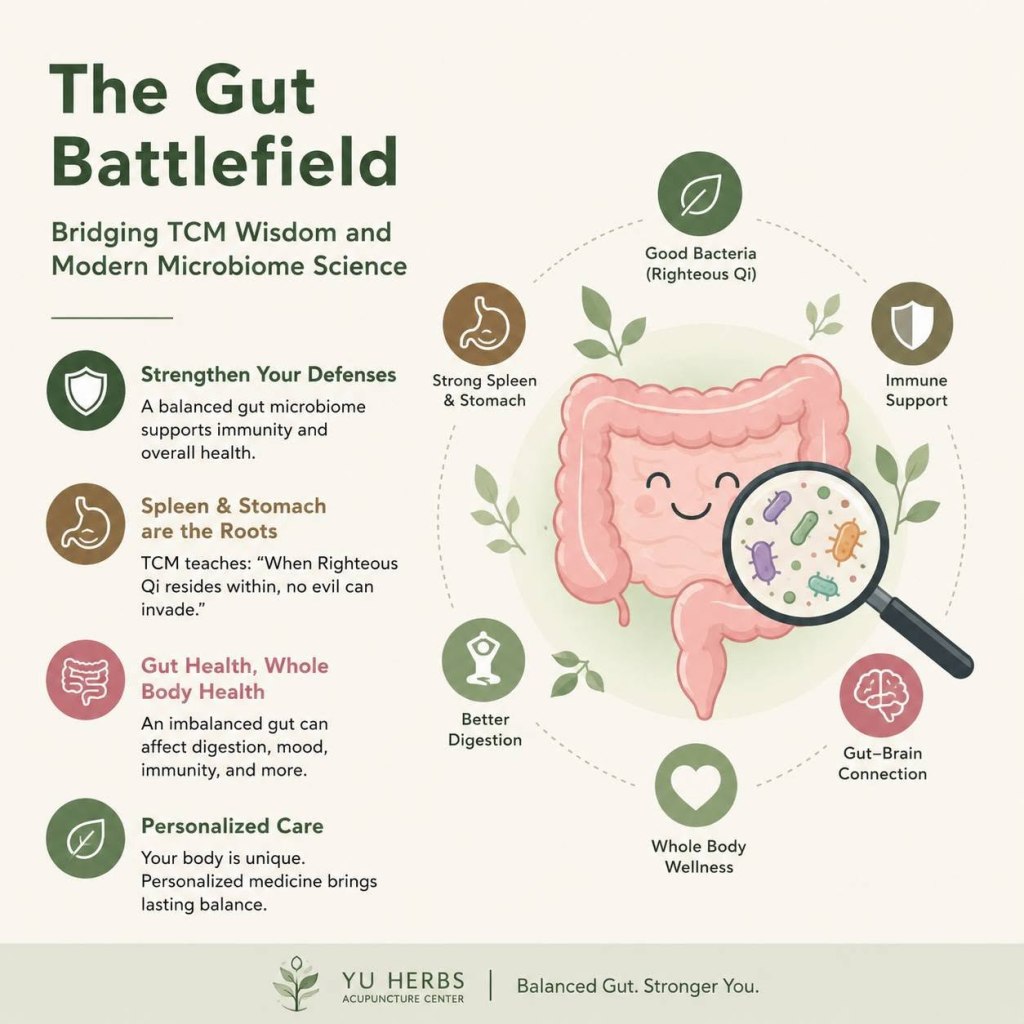
腸道裡的「正邪大戰」:中醫帶你用現代科學看肚子裡的「微生態」
走進中醫診室,你可能常聽醫生說:「人以胃氣為本」、「脾胃為後天之本」。很多人以為中醫說的脾胃只是消化食物,其實,這在中醫裡是一個巨大的防禦與運化系統。
有趣的是,現代西醫近幾年通過無數權威科學期刊發現:人類的腸道裡住著100兆個細菌,被稱為「腸道菌群」。這群細菌的消長,竟然跟中醫說的「脾胃正氣」不謀而合!今天,我們就用中醫的「正氣與邪氣」,結合現代西醫的頂尖研究,帶大家看看肚子裡這場攸關生死的「細菌大戰」。
一、 中醫的「正氣」與西醫的「益菌」
中醫講:「正氣存內,邪不可干。」意思是只要身體的抗病能力強,外來的病毒、壞菌就無法作怪。當然,這是有條件限制的,並不是說只要免疫系統夠強,我們就會刀槍不入,這只是以一般的情況來說的,如果外來的病毒、細菌太強,一次進入人體的數量太多或毒素太多,人體還是會生病的,這個是需要事先了解,不能搞混的。
在現代醫學看來,這腸道裡的「正菌(益生菌,如雙歧桿菌、乳酸桿菌)」就是我們腸道裡的正氣。權威醫學期刊《PMC》的免疫學綜述指出,健康的腸道菌群會分泌短鏈脂肪酸,它們就像是腸道黏膜的護衛,負責訓練我們的免疫系統,不讓毒素隨便跑進血管。
如果你的「正氣」充足,腸道菌群平衡,身體就能順利運化水穀精微(吸收營養),氣血自然充沛,這就是中醫說的「脾胃健旺」。
二、 菌群失調:例如中醫的「脾虛濕盛,外感直中脾胃」引發全身慢性病
如果正氣虛弱,壞菌(邪氣)就會抬頭,西醫稱之為「菌群失調(Dysbiosis)」。這在中醫眼裡,就是典型的「脾虛濕盛,外感傷脾,內生百病」。
當腸道壞菌太多,它們會破壞腸胃黏膜,造成西醫所說的「腸漏症(Leaky Gut)」。這時,壞菌產生的毒素(如內毒素、咪唑丙酸等)就會漏進血液裡,隨著血液循環流向全身,引發全身性的慢性發炎。
根據權威醫學期刊《Nature》與《Cell Host & Microbe》的最新研究,腸道壞菌引發的慢性發炎,會導致以下問題:
* 心血管疾病與三高: 壞菌產生的代謝物會加速血管斑塊堆積,干擾胰島素訊號,引發糖尿病與心臟病。
* 大腦與神經病變: 醫學界證實了「腦腸軸(Gut-Brain Axis)」的存在。腸道菌群亂了,會透過神經與免疫系統影響大腦,增加帕金森氏症、阿茲海默症(失智症)以及憂鬱症的風險。
這正印證了中醫那句老話:「內傷脾胃,百病由生。」肚子沒照顧好,全身都要出問題,連免疫系統的運作都會出問題。
三、 觸發癌症的隱形推手:邪氣留滯,日久成「積聚」
最讓人心驚的是,腸道壞菌還可能成為癌症的催化劑。中醫認為癌症是「邪毒內蘊,氣滯血瘀,日久成積(腫瘤)」的過程。
醫學權威期刊《Cancer Biology & Medicine》在2026年的癌症與微生物專刊中明確指出:腸道細菌不再只是旁觀者,而是癌症的「主導驅動者」。
壞菌是如何誘發癌症的?
* 直接破壞DNA: 某些特定的壞菌(如具核梭桿菌、特定的大腸桿菌)會分泌毒素,直接損傷我們大腸細胞的基因,誘發細胞癌變。
* 癱瘓免疫系統: 它們會建立一個「保護傘」,讓身體的免疫細胞(T細胞)瞎了眼,看不見癌細胞,甚至讓癌症免疫治療(PD-1等)失效。
* 斬草未除根的風險: 哈佛大學公共衛生學院2026年發表在《Cell Host & Microbe》的研究更發現,許多大腸息肉(癌前病變)患者在切除息肉十幾年後,腸道裡的壞菌和有害代謝物居然還維持在「高風險狀態」!這意味著,光是開刀切除病灶,若不調理腸道的「微生態環境」,癌症的種子依然在土裡蠢蠢欲動。這也是為什麼很多人平時沒感覺到什麼症狀,卻不知體內長期都有慢性發炎的情況。
四、 迷思破解:腸道感染、不舒服,吃益生菌就會好?
很多病人都會問我:「賴醫師,既然壞菌是邪氣,那我天天吃益生菌(補正氣),腸胃病是不是就會好?」
我明確地告訴你:這是天大的誤區!
很多人以為腸道感染(拉肚子、急性腸胃炎)或長期嚴重便秘,只要吞幾顆益生菌膠囊就能藥到病除。從現代醫學和中醫的角度來看,這有兩個致命問題:
* 西醫觀點——「遠水救不了近火,甚至幫倒忙」:先不論有些益生菌產品,並無法通過胃腸道的強酸(胃酸)與強鹼(膽鹽)的考驗到達腸道(所以這就是為什麼選擇益生菌產品是需要找你的家庭醫生、營養師等專家諮詢),當腸道已經處於嚴重發炎或壞菌過度滋生的狀態時(例如小腸細菌過度生長 SIBO),你的腸道就像一個已經打得不可開交的戰場。這時候盲目塞入大量的益生菌,它們不但無法定植(活下來),反而可能加入混戰,引發更嚴重的腹脹、腹痛或免疫過激反應。
* 中醫觀點——「虛實不分,盲目亂補」: 中醫治病講究「實則瀉之,虛則補之」。腸道被壞菌(邪毒)佔據時,首要任務是「驅邪(清熱解毒、通腑導滯)」,而不是「盲目進補」。如果體內濕熱淤積,你拼命吃益生菌,就像在發霉的牆壁上直接刷油漆,根本沒有解決根本的土質問題。
益生菌是「保養品」,而不是「萬靈丹」。當腸道已經生病,必須先尋求專業醫師診斷,透過藥物(中藥調理解毒,或西藥抗生素、抗發炎藥)把戰場清理乾淨、把邪氣驅逐後,後續補充益生菌才有意義。
臨床上可以看到不少病人跟我說,我平時身體都很健康,飲食運動都有注意,甚至吃素,怎麼突然一次的健康檢查就發現癌症,其實很多人都自以為吃素就是健康,那是不對的,就像我之前的文章一再強調,什麼樣的飲食對你的身體才較健康是要專業醫生判斷的,每個人的體質不同,不能一概而論,不適合你身體的飲食就會損害胃腸道系統。況且很多人認為我的肚子只是偶爾不舒服,並不會痛,所以我胃腸一定很健康,又或者有的人吃完食物就會想睡,覺得那是正常,其實很多小訊號已經告訴你該要好好注意你的身體了。你的身體健不健康,不是你自己認為,是要經過專業醫師判斷的。所以平時只要好好注意你自己的身體,進行適合你本身的飲食與運動,身體有小毛病都及時處理,才能遠離疾病。

